
Snowflake Dynamic Tables: From Automated Refreshes to an Intelligent Data Platform
Snowflake Dynamic Tables have evolved far beyond simple pipeline automation. With Adaptive Refresh, Multi-Table Refresh, and DML on frozen regions, they are becoming the default orchestration layer for modern enterprise analytics.

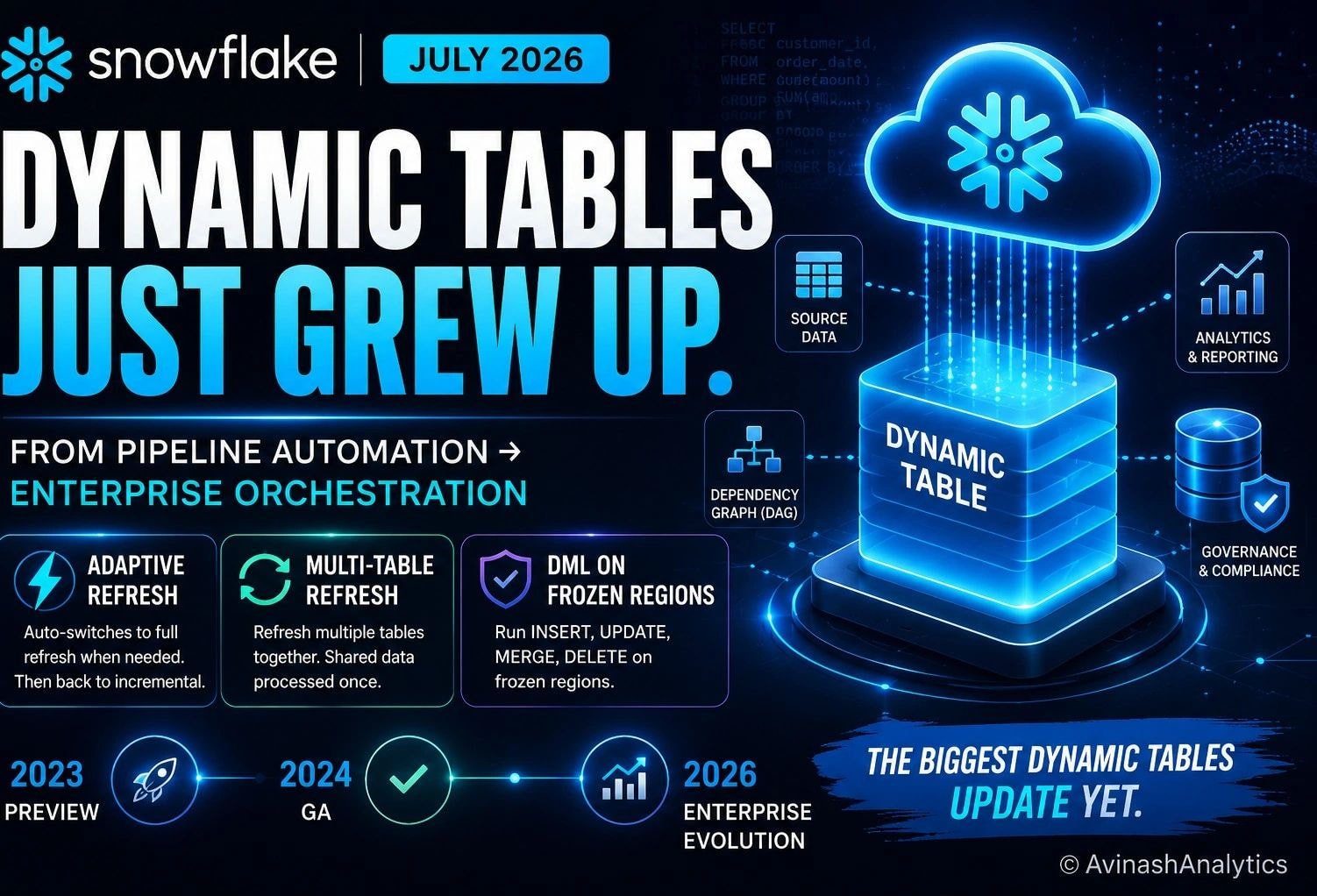
Snowflake Dynamic Tables: From Automated Refreshes to an Intelligent Data Platform
When Snowflake introduced Dynamic Tables, many data engineers viewed them as a convenient way to simplify ELT pipelines. They automated data refreshes, reduced the need for complex scheduling, and made pipeline development easier. While these capabilities were valuable, Dynamic Tables initially appeared to be an incremental improvement rather than a transformative shift in data engineering.
Fast forward to 2026, and that perception has changed significantly.
The most interesting aspect of Dynamic Tables today is not any single feature, but the overall direction of the platform. Over the past few years, Snowflake has steadily evolved Dynamic Tables from a simple automated refresh mechanism into a system that increasingly understands how modern enterprise data platforms operate. The latest enhancements reinforce this evolution.
Adaptive Refresh
One of the most significant advancements is Adaptive Refresh.
Traditionally, engineers had to decide whether a Dynamic Table should perform an incremental refresh or a full refresh. This decision required understanding data volumes, workload patterns, and operational trade-offs — and getting it wrong meant either wasted compute or stale data.
Adaptive Refresh removes much of this complexity.
Snowflake now automatically determines the most efficient refresh strategy based on the volume of upstream data changes. During normal operations, it performs incremental refreshes to minimise compute costs. When a large volume of data is ingested, the platform intelligently switches to a full refresh for that execution cycle before returning to incremental processing.
This capability reduces manual configuration while optimising both performance and operational efficiency. For data engineering teams managing dozens of pipelines, the cumulative impact on compute spend and operational overhead is substantial.
Multi-Table Refresh
Large-scale data platforms often contain multiple Dynamic Tables that depend on the same upstream datasets. Traditionally, refreshing these tables independently could result in redundant processing of shared dependencies — increasing both execution time and compute costs.
With Multi-Table Refresh, Snowflake understands the complete dependency graph across Dynamic Tables.
Instead of repeatedly processing shared upstream objects, the platform refreshes them only once and propagates the results throughout the dependency chain.
Although this may appear to be a small optimisation, it can significantly reduce resource consumption and improve refresh performance — particularly during large backfills or enterprise-scale data processing workloads. For organisations running complex DAG-based pipelines, this translates directly into lower cloud bills and faster data availability.
DML Support on Frozen Regions
One of the most impactful enhancements is support for Data Manipulation Language (DML) operations on frozen regions.
Historically, immutable or historical data partitions were often treated as untouchable because modifying records required rebuilding an entire Dynamic Table. This limitation complicated governance processes, compliance corrections, and data quality improvements — particularly for organisations operating under GDPR, DPDPA, or financial regulatory frameworks.
With this enhancement, organisations can now execute INSERT, UPDATE, MERGE, and DELETE operations on frozen regions without reconstructing the entire Dynamic Table.
For enterprises operating under strict regulatory requirements or maintaining high standards of data governance, this represents a meaningful improvement in operational flexibility. Compliance teams can now correct records, apply right-to-erasure requests, and fix data quality issues without triggering expensive full rebuilds.
The Evolution of Dynamic Tables
The progression of Dynamic Tables over the past few years highlights a clear pattern of platform maturity:
| Year | Milestone |
|---|---|
| 2023 | Introduction of Dynamic Tables — preview availability |
| 2024 | General Availability, enabling production adoption |
| 2025 | Performance improvements, enhanced monitoring, broader enterprise usage |
| 2026 | Intelligent orchestration, lower compute costs, stronger governance capabilities |
This progression reflects more than incremental feature development. It demonstrates Snowflake's broader strategy of reducing operational complexity and embedding intelligent decision-making directly into the platform — shifting the burden from the engineer to the system itself.
Looking Ahead
As enterprise data platforms continue to evolve, the role of Dynamic Tables is expanding beyond automated ELT pipelines.
Features such as Adaptive Refresh, dependency-aware execution, and flexible data management indicate a future where orchestration becomes increasingly autonomous. Rather than requiring engineers to manually optimise refresh strategies and pipeline dependencies, the platform itself makes many of these decisions.
This shift allows data engineering teams to spend less time managing infrastructure and more time delivering business value — which is ultimately what every enterprise data investment should enable.
If Snowflake continues along this trajectory, Dynamic Tables may evolve beyond being an ELT feature into becoming the default orchestration layer for modern analytics workloads. By continuously eliminating manual operational decisions while improving efficiency, governance, and scalability, Dynamic Tables are steadily becoming a foundational component of intelligent enterprise data platforms.
Final Thoughts
The evolution of Dynamic Tables illustrates a broader trend in modern data engineering. Platform innovation is no longer defined solely by the addition of new features, but by the removal of manual decisions that engineers have historically been responsible for making.
Adaptive refresh strategies, dependency-aware execution, and flexible management of historical data all point toward a future where data platforms become increasingly autonomous.
For organisations building scalable analytics solutions on Snowflake, this represents an important step toward more intelligent, efficient, and maintainable data architectures. The question is no longer whether to adopt Dynamic Tables — it is how quickly your team can migrate existing pipelines to take advantage of what the platform now offers.
AWA Solutions helps enterprise clients design and implement modern data platforms on Snowflake, AWS, and Azure. If you are evaluating Dynamic Tables for your data engineering stack, get in touch — we would be glad to share what we have seen work at scale.
Explore Topics
Written by
AWA Solutions
Data & AI consultancy helping enterprises unlock the value of their data.


